My father, generosity incarnate

It has been nearly 20 months since I preached this homily at my father's memorial service; nearly two years since his death in January of 2024. Grief is an odd thing. I couldn't bear to revisit this piece for the longest time. But, this Thursday, he would have been 89. In honor of his birthday, I'll set this here and invite us all to light a candle for our loved ones, and consider the ways that we, too, may become generosity incarnate.
March 16, 2024
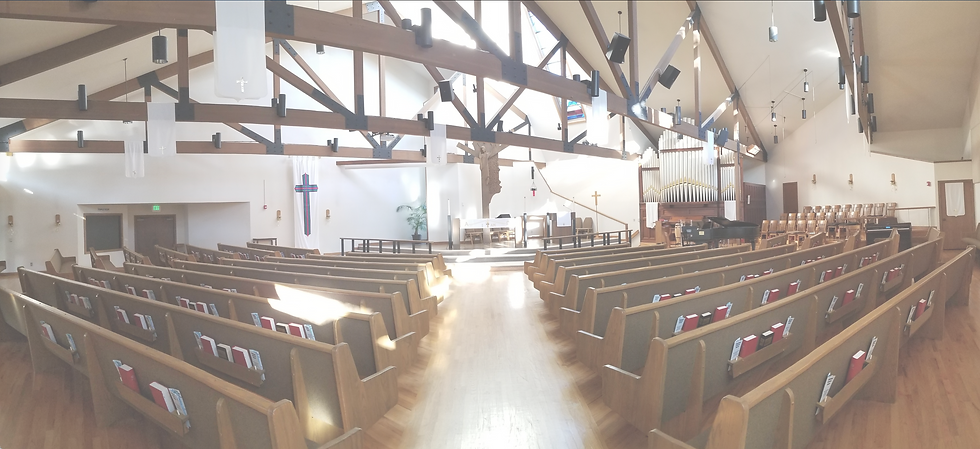
Bethany Lutheran Church
My father is generosity incarnate. Whether it was to lend a hand, or a fishing pole; to share some time and knowledge; to gift a filet of smoked fish or a plate of cookies—these were all his trademarks. His generosity was remarkably ordinary, lived out in the day-to-day attentiveness to the present, and to those around him. (Chances are, if you’re here, you’ve been on the receiving end of that generosity.)
Reflecting on my father’s life, I wondered about where such generosity came from. (And) I suspect that the seeds of generosity were likely sown during wartime in rural MT. The messaging of boyhood and scouting life would have included the principles of doing good for others, working together for something greater than oneself. And in such an environment, this is where he was raised, in part, by folks from the small town of Fairfield. It’s where remarkably ordinary people looked after him following his mother’s early death, when his own father was not available. I remember when we went back for visits, we always had to stop in to see Mrs. Crawshaw—known for her detailed crochet work and, still driving around town in her nineties, for getting into some fender-benders.
Those seeds, over time, germinated in places of rootedness and belonging, like the island community here, and this church. Nourished by the waters of the Puget Sound region, by creeks and rivers, among fly fishing compatriots and boating buddies, those seeds grew into full expressions of generosity made material in time, patience, and presence—generosity incarnate. To say that something is incarnate is to say that that which is normally unseen takes on form, becomes earthy, fleshy, time-laden substance. It becomes something we can experience and share. It is a religious term, a theological term, but with radically earth-bound implications.
And while I wouldn’t say that my dad was an overly religious man—particularly given the connotations such language insinuates these day—he was always a person of faith, alongside the science. (Church membership runs deep in the Daley clan. It was his side of the family, after all, that produced a generation or two of itinerant preachers.) Faith, and science nested together among life-giving waters. From the experience of awe amidst rambling mountain streams, along with data-driven analyses of healthy aquatic systems emerged a unique way of being in the world. Here I’m speculating, yet I sense that my father’s incarnate generosity was learned from his own observations of the divine economy that is the abundance of creation.
Through his vocation as a fisheries scientist, Wayne stood witness to the ways creation teaches us about gifting and receiving, about ebbs and flows, about cycles of salmon and trout that surge at different times of the year. We learn so much from the salmon. It’s the salmon who instruct us in the divine economy as they give themselves up to provide marine nutrients far inland, forming the basis of our (compost) rich evergreen forest ecosystems. It is the salmon who act as communion host for so many other creatures, from orca to grizzly, eagle to aquatic bacteria.
We started this service with a special prayer—the thanksgiving over the water. This prayer is significant for a few reasons. To begin with, it is a central part of the baptismal liturgy that signifies new life and spiritual rebirth for Christian initiates. For my father, that new life has now come full circle. So, it’s an appropriate occasion to give thanks for the water as we honor his passage from this earthly life to full participation in the divine life.
Secondly, the simple act of expressing gratitude for the gift of water is a profoundly radical practice. Water is something that we (human creatures that we are) can neither create nor destroy. We are fully dependent upon providence and climate, even as we exacerbate ecological feedback loops and create new environmental crises. At times it’s hard to think of water as a gift in light of the destructiveness seen in recent flood events or its debilitating scarcity. However, in baptism, we encounter water in its life-giving form, hearkening back to the beginning, when water and Spirit brought creation into being. In baptism, and in our remembrance of baptism, water and Spirit once again join together to bear forth new life. This is the gift.
This particular prayer is unique in that it is geographically specific. Pastor Erin and I adapted it from Holden Village, from their Easter Vigil service (as recounted by Lutheran scholar and Holden faculty Ben Stewart). By naming the waters we honor the places that form us. When we take a moment to pause and think about how we know water, what it means to understand the significance of water, that’s when it becomes apparent we cannot know water apart from location, or particular moments and events when water invaded our consciousness. We connect with certain waters at certain times.
The waters that flow through Holden Village are special in and of themselves. The prayer for Holden Village says, “Praise to you for Isella Glacier and Railroad Creek, for Lake Chelan and Columbia River”—all waters that my father knew very well. Others will be able to share the details better than I, but he spent a great deal of time with Railroad Creek, especially during the summer when they installed a new water system for the village. Shortly after that, the rain birds protected Holden Village from severe wildfire in 2017. (And, before you ask if I have ever been to Holden Village: no, not yet. But when I do go, I will be sure to send along greetings to the creek and to the birds.)
From Freezeover Lake in Fairfield, MT, to the banks of the Stillaguamish, from the mudflats of Fletcher Bay, to the waves of Lake Chelan, my father’s world was nourished by life-giving waters. And he shared his knowledge and love for these waters, and for the island creeks feeding into the groundwater system, with anyone who would listen. So, we give thanks for water today.
I appreciate that my father landed in the Lutheran tradition, as far as church traditions, go. As an Episcopal preacher, I am envious of the ways Lutheran scholars have entwined ecology and theology, in part thanks to Martin Luther’s respect for the book of nature and the elements of creation that make up the sacraments of baptism and communion. In his treatise on baptism, Luther said that “the lifting up out of the baptismal water is quickly done, but the thing it signifies—the spiritual birth…even though it begins in baptism, lasts until death.” The practice of baptism is an opportunity to remember that each one of us began our existence in water.
Life begins in water, seeds germinate with water, and we all require just enough to flourish and thrive on this planet. So, if there is one thing we could do to honor my father, it would be to continue advocating for clean water, for access, for open rivers, for the fish.
I said at the beginning that he is generosity incarnate because the story of Wayne Daley is written here, among all of us who received his generosity. The material expression of gifting ourselves in remarkably ordinary ways continues as we go out and do likewise (share a plate of cookies, share your knowledge and stories with others, wash dishes, refill the oil candle, etc.). And so, I encourage you to carry out the Daley tradition in your own way.
Comments